
The Silent Majority is Stuck in the Middle Again!
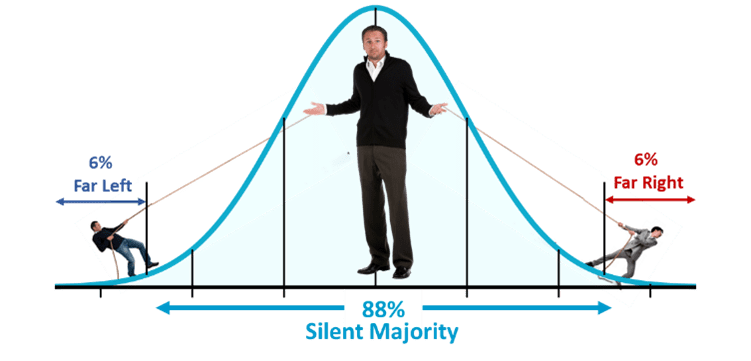
The Silent Majority is too Silent!
Silence is Not Golden
I think it would be very difficult to find any U.S. citizens who are even a little satisfied with our current divisive political climate. About 49 of 435 House of Representative members (11.2%) are part of the far-right Freedom Caucus1 and according to Pew Research, the far-right represents only 6% of U.S. voters2. About 100 U.S. Representatives (just under 23%) are members of the far-left Progressive Caucus3 advocating for more government support for economic, political, and social democracy. Pew Research also estimated 6% of all voters align with the far left4. Assuming these statistics are reasonably accurate, then 88% of voters are somewhere in the middle. Richard Nixon called this grouping, “The Silent Majority!” I never liked Nixon, but I think the Silent Majority is an excellent way to categorize voters like me, who fall somewhere in the middle.
How Can the Largest Group of Voters be Silent?
In my opinion, there are five primary reasons that keep the majority silent:
- The two extremes are clearly the most passionate and well-funded factions of their respective political parties. They are the most effective at getting their message out. They relentlessly bombard news and social media. Leaders of the two extremes have the loudest (and most obnoxious) voices and effectively use fear to influence their audience.
- The two extremes are the most intolerant and don’t believe compromise is an acceptable option. They would rather blame and vilify anyone with opposing views rather than collaborate and engage in respectful dialogue with opposing viewpoints. In a closely divided congress, they hold just enough members to obstruct any legislation they don’t like. Big money has corrupted politicians and eroded trust in elections. We are in an era of sound-bite politics with the where a small and often obnoxious group of congressional talking heads who strategically position key issues as strictly binary choices.
- The two extremes have mastered manipulation of facts, deception, and outright lyng to achieve their goals. It seems when persistently telling a lie or manipulating the truth, it creates a perception that it must be true. An obvious example is all the claims that the 2020 election was stolen with massive fraud. The extremes leverage media networks such as FOX, CNN, MSNBC, NewsMAX, etc., along with online news and social media sources that are not objective, do not adequately fact check, and play to a loyal base.
From 1954 until 1987, the media was regulated by the Fairness Doctrine5. This was put in place when congress was concerned that the 3 major broadcast networks (ABC, CBS, & NBC) might abouse their monopoly control to promote biased agendas. The Fairness Doctrine was repealed in 1987 by the Reagan administration. It not surprising whenever Fox News has been in litigation for misrepesenting facts, they deliberately refer to themselves as “entertainment”, vs. a news station. Without the Fairness doctrine, there is no requirement for the media to be factually accurate or unbiased. Therefore, the burden is on their audience to determine where the truth lies (pun intended).

- Common sense isn’t so common. Stated another way, too many voters are not capable or not interested in applying critical thinking skills. The extremes effectively use innuendo, half-truths, manipulation of facts and fear-mongering to fire up their base. It is effective because their respective core voters see or hear a gripping headline from their trusted sources and/or “talking heads”, and it’s blindly accepted as fact. I think it’s effective because the loyal base of voters must be very gullable or they cannot/will not accept there are other perspectives to consider.
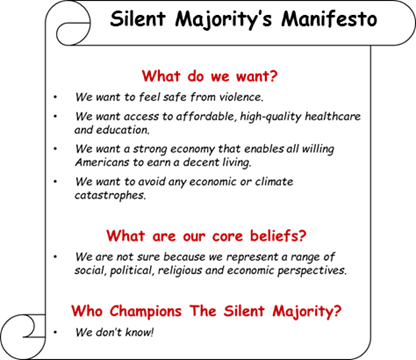
- There are no effective leaders representing the 88% of voters in the Silent Majority. This is not surprising considering the 88% represent a diversity of viewpoints on key political topics such as abortion, gun control, government services, tax policies, environmental policies, DEI (Diversity, Equity & Inclusion), etc.
Probably, the points above are not new or surprising. I suspect most voters will agree that our political process is broken (or breaking down) and needs to change. I am very worried about the consequences of inaction. For example, let’s assume Trump and Biden are the candidates in the 2024 presidential election. What will happen if Biden wins another close election, or if Trump wins by a close margin? Either outcome can easily lead to civil unrest, violence, rioting, and even more political divisiveness.
What Can Be Done to Fix a Broken Political Process?
I wish I knew! I do think there may be some options worth exploring which are outlined below. I admit these are generalized examples and it’s easy to dismiss each as too simplistic, unrealistic or silly. But, at some point, there has to be an end game, a defined goal. Without and end in mind, we will never make any progress.
- Leverage a Purple Platform to Neutralize Binary Majority/Minority Parties. Can we move away from our strict red and blue two-party political system? If no party has a majority of congress, getting anything done would require cooperation and collaboration across the aisle or aisles. What a novel idea. However, if moving away from the two party model is not feasible, then maybe we should promote a “Purple Platform.”
- A Purple Platform – Winston Churchill famously said, “Democracy is the worst form of government, except for all the others.” In the political spectrum, the voices of the far-right trends towards Libertarianism, advocating for the least amount of government intervention and oversight possible. The far-left trends towards social democracy where government services and regulations are necessary to protect individual liberties, prevent business malfeasance (corruption, pollution, unfair labor practices, etc.), and to ensure Diversity, Equity and Inclusion is used to help level the playing field, and provide accessible healthcare.
My hope is that our elected officials will finally accept that the 88% of the population that lands somewhere in the middle are alienated by both extremes. In my opinion, the far right and Libertarianism seems too harsh and lacks sufficient oversight & safety nets that can make us all vulnerable to financial, environmental, health, and public safety catastrophes. At the other end, Progressive liberalism (far-left) seems too expensive and bureaucratic and can blur the line between a helping hand and a hand-out. I’d like to see a third caucus, “The Moderate Caucus”. The Moderate Caucus can establish a platform around centralist policies, civility, and collaboration. If it can establish a large block of bi-partisan representatives, it has the power to reject blind party loyalty and can attract political support and funding. Perhaps the Moderate Caucus could help neutralize the extremes and eliminate politicians from being indebted to extreme big-dollar donors in order to get elected. - Establish a Credible Fact-Checking Process. Can we establish an independent fact-checking organization that goes well beyond what Snopes (www.snopes.com) or Factcheck.org can offer? I think it would be fantastic to have access to clear and concise information covering all viewpoints on key issues that is supported with validated facts and data. Ideally, the fact checking process includes active participation and an endorsement from all major political parties? Hard to imagine this happening but, maybe it’s in the art of possible.
Footnotes:
1 Pew Research Center (https://www.pewresearch.org/short-reads/2023/01/23/freedom-caucus-likely-to-play-a-bigger-role-in-new-gop-led-house-so-who-are-they/)
2 Fortune (https://fortune.com/2018/10/22/far-right-americans-just-six-person-study-says/)
3 Progressive Caucus Members (https://progressives.house.gov/caucus-members)
4 Beyond Red vs. Blue: The political Typology (https://www.pewresearch.org/politics/2021/11/09/beyond-red-vs-blue-the-political-typology-2/)
5 Fairness Doctrine (https://www.reaganlibrary.gov/archives/topic-guide/fairness-doctrine)
 Random Thoughts from the Active Mind of Dan Saltzman
Leave a comment