
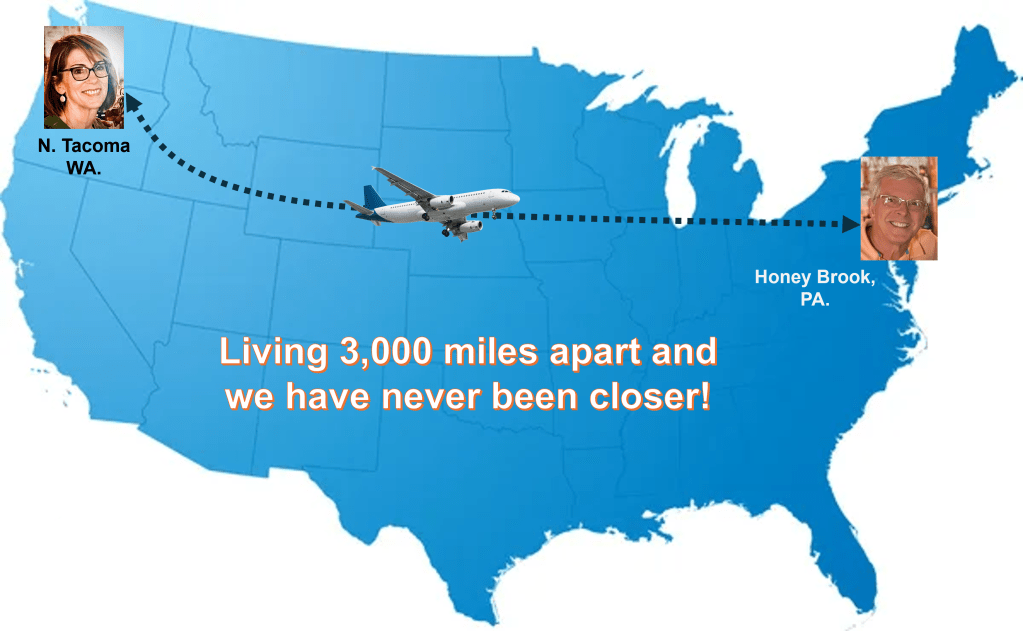
Our life together was great in Honey Brook, PA. Then things changed! Kris and I have been in a long-distance relationship for the past 6 years and it may continue for a quite a while longer. It’s not been easy, but we seem to have figured out how to make it work for us.
Table of Contents
- Why we are in a long-distance relationship.
- Six strategies that are enabling our long-distance relationship to work.
- It will be OK in the end. If it’s not OK, it’s not the end.
I. Why we are in a long-distance relationship.
Kris Chiappa and I are about to celebrate our 10-year anniversary as committed partners. We met in 2014, fell in love, and bought a house together in Honey Brook, PA in late 2016. Life was great! We love our house and our life together. We had been thinking about moving to the Pacific Northwest at some point after I retired (which occurred in 2023), but we did not have a specific time frame. However, everything changed in early 2018 when Kris got a call from her daughter, Joanna who lives in Washington, State. “Guess what mom, I am pregnant.” And about a month later, another call, “Guess what mom, Manny and I are having twins!” Kris’s twin granddaughters were quite premature and spent their first 6 weeks in the NICU. Fortunately, they are healthy, happy and intelligent girls.
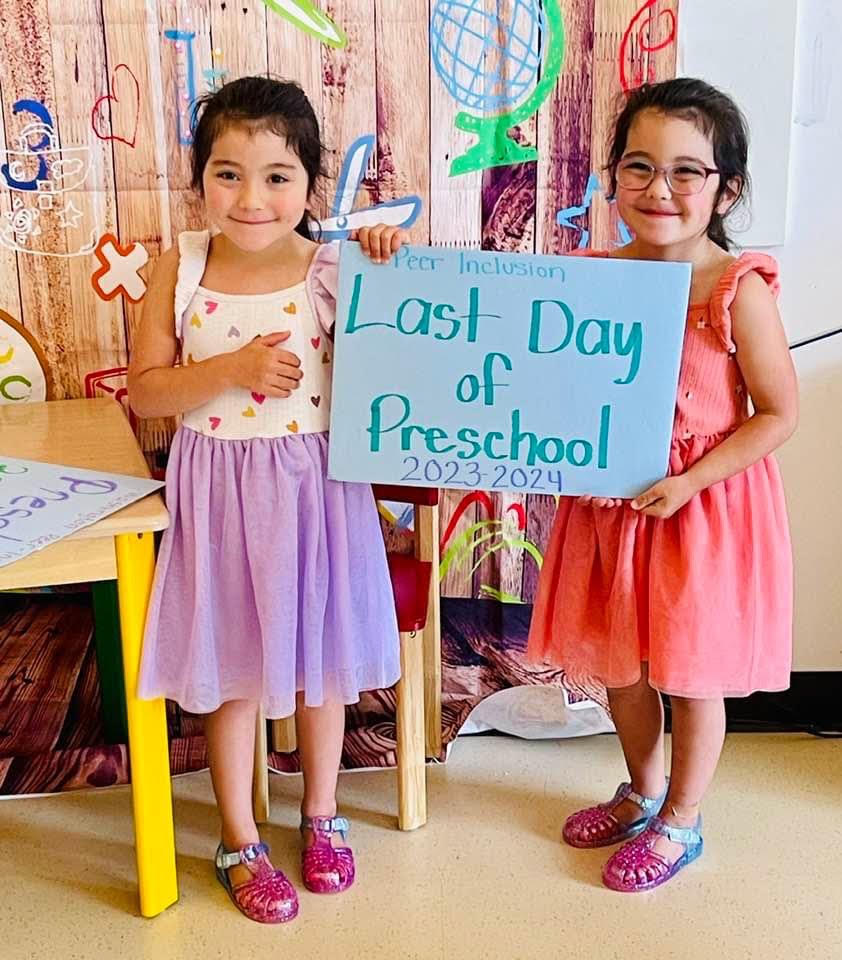
Kris is needed in North Tacoma.
It takes a village to raise twins and especially when childcare for twins is unaffordable. For a variety of reasons, it has ended up that Kris is now “the Nanny in charge” and has pretty much set up residence in the guest room of her daughter’s house in N. Tacoma, Washington. Not an ideal living situation for Kris to give up her comfy Honey Brook lifestyle as well as the convenience and privacy of living in her own home. We did ship a car and Kris’s horse, Odin out to Tacoma which enabled Kris to have more independence and opportunities to spend rejuvenating time outside her daughter’s house working with Odin, hiking, and socializing with her new West Coast friends.
I am needed in Pennsylvania.
We will eventually sell our house in Honey Brook and find a place in the Pacific Northwest, but just not yet. I have my own family challenges on the East Coast. In 2021, it became clear that my 95-year-old father and his wife, Janet were no longer able to live in the large house they owned since 1983. It took a lot of time, patience, persistence by my siblings and me to convince them it was time to move to a continuous care community. I will spare the details of what that effort required although I could write a book about it all.
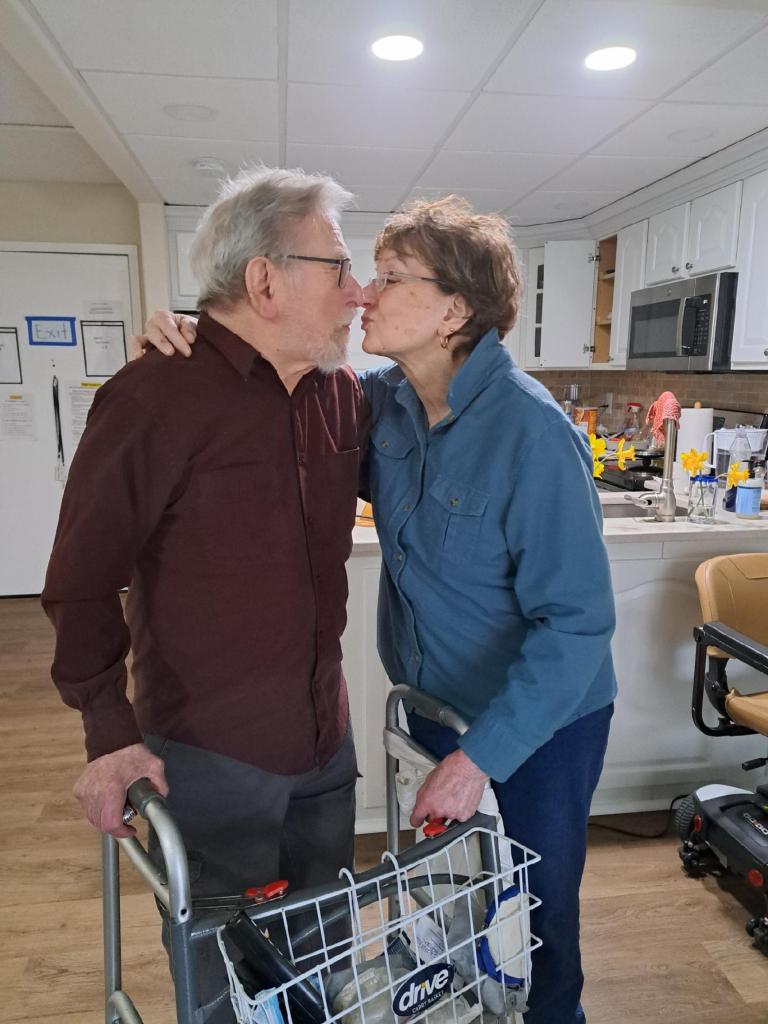
My dad, now 98, is no longer ambulatory other than very short distances with a walker. Fortunately, he is still all there mentally and still amazes me with his ability to recall from memory all the phone numbers of the important people in his life as well as his credit card numbers. I cannot do that! Unfortunately, Janet is entering the latter stages of Alzheimer’s which has her both physically and mentally impaired. Consequently, they are both in the high-maintenance stage of geriatric care. I am grateful my siblings all pitch in and we divide up the work to manage finances, healthcare, transportation and shopping. I make the 1-hour trip to their facility 1-2 times per week plus numerous times I’ve had to dash over to get one of them to urgent care.
Family comes first.
Kris could not live with herself if she was not present to support her daughter and granddaughters in N. Tacoma. And I could not live with myself if I decided to move to the west coast now, while my dad and Janet are in such a high-maintenance, geriatric situation. Kris and I understand and support each other’s decision to be where our respective families most need us. We committed to making this less-than-ideal situation work.
II. Six strategies that our enabling our long-distance relationship to work.
1. Focus on being mindful and present when we talk each day.

While we are on opposite coasts, Kris and I generally have very busy days. We occasionally text each other to check in, but we both look forward to our nightly phone call. That call keeps us connected and it’s the best part of my day. Talking once a day creates a different dynamic compared to the convenience of ongoing conversations when are both in the same venue. We are mindful that our nightly call is the one daily opportunity to really feel connected.
When Kris and I talk each night, we are both alone and try to avoid distractions from our phones or TVs. We are 100% focused on each other. I love feeling how we are both present and truly interested in hearing about each other’s day. More importantly, our conversations feel very meaningful. Some days we don’t have much to discuss, but most days we seem to delve into some interesting and deep discussions. Our conversations may last less than 30 minutes or over two hours. Regardless of the duration, our nightly calls rejuvenate and inspire me. We generally talk just before I get ready for bed, so when our call ends, I feel my day is complete.
Finally, Kris and I always end each call by telling each other, “I love you and I miss you!”. What is truly powerful is that it’s not just words. We both state it with intention, and I can feel the love, even if we are 3,000 miles apart most of the time.
2. Find ways to reduce the cost of spending time together.

Spending time together is not easy when we are on opposite coasts. When either of us travels, it can be disruptive for the family members we help care for (plus expensive to fly across the county). Our goal is to never be apart for more than 2 months (generally less). We try to follow the guidelines below to best manage our budget and family impact:
- We try to plan our get togethers well in advance to get the best airfares and to enable our family members plenty of advanced notice to plan alternative childcare/eldercare while we are away. Generally, we have our travel plans booked at least 6-12 months into the future.
- As much as possible, we try to schedule our travel to minimize the impact upon our respective family. For example, I traveled to Tacoma when Kris’s granddaughters were on Spring Break and Manny, the twins’ dad, was traveling to Mexico with his family. I could help watch the twins and Kris could spend time with her horse during the day vs. rushing to the farm after her daughter finishes work.
- We look for bargains and discounts to save money. For example, Kris signed up for an Alaska Airlines credit card that gave her 75,000 free miles. We can get round trip airfare between Philly and Seattle for under $500 by booking well in advance.
3. Celebrate when we are together.

When Kris and I do get together, we try to find activities that we both enjoy, facilitate meaningful conversations and nurture our relationship. We try to plan special events with each trip to make them more memorable.
Some examples:
- We have a tradition to go out to a nice, romantic dinner on the last night we will be together.
- We generally arrange to hike together every day we are together (weather permitting). We both love to hike, and a good hike invigorates us.
- On my last trip to N. Tacoma, Kris surprised me with a Memorial Day weekend escape to Bellingham, Washington and the San Juan Islands.
- Spend quality time with our family and close friends that we don’t see regularly. Whenever I am in Tacoma, we try to get tother for dinner with some great friends who live nearby in Lacey. We may drive a few hours to spend a weekend with Kris’s sister & family in Vancouver, WA. We recently had a fantastic vacation with two good friends at VRBO house in Santa Fe, NM. In September, Kris and I will meet at my sister’s house in Scottsdale, AZ. In October, we are planning a special weekend with Kris’s family in the Columbia River Valley for a weekend music and wine festival. When Kris is in Honey Brook from mid-December into January, we will celebrate Christmas with my family then travel to the Outer Banks for a relaxing week with Kris’s siblings at a beautiful house on the beach.
- When we are together, we try to provide some relief and support for each other. When in Tacoma, I will encourage Kris to go work with her horse, Odin in the middle of the day and let me watch the kids. When I’m not in Tacoma, Kris must rush to the farm as soon as her daughter finishes work to squeeze in as much time as possible to work with Odin and take a hike, before it’s too dark. When Kris is in Honey Brook, she always asks spends time with my family in the Philly area, especially quality time with my father and his wife at their assisted living community.
4. Take care of our Mental & Physical Health.
Being apart more than together, it could be easy to get depressed, lonely, or angry with our situation. Kris and I work on activities to help with our self-care.
- Having a pet helps. Several months ago, Kris adopted Alfie, a tiny, intelligent dog who lives with her in N. Tacoma. I have my lovable and very energic dog, Baxter and two cats with me in Honey Brook. We both take our dogs on a daily hike, and they provide great companionship. Alfie is small enough to travel under the seat on airplane fights and accompanies Kris on almost all her trips
- Building and maintaining friendships is also crucial for both of us. Kris has a few new and meaningful friendships out West who share similar interests. Kris has a very close friend named Susan. They both have a rescue dog and love to hike. Generally, 5 days per week, Kris and Susan (and their dogs) go on a hike together at various great venues near Odin’s farm. Greg and Sally own the farm where Kris boards Odin. They are incredibly nice and treat Kris & Odin like family. My 2 daughters, both married, live near me. I also arrange regular meals out with some friends in my neighborhood and long-time friends in the area.
- Kris takes Pilates classes 2-3 times per week.
5. Embrace Our Independence.

Kris and I enjoy a strong emotional connection, but we both need and appreciate our independence and alone time. Our core values and priorities are very well aligned even though we have very different personalities styles. I’m an extrovert, Kris is an introvert. Kris can be highly sensitive; I can be oblivious. Kris is patient, a great listener and very introspective. She will rarely speak without carefully considering exactly what she wants to say and when she wants to say it. I’m less patient. I have ADD. I am a verbal processor (I tend to think out loud), and I can be too quick to react to a situation. Bottom line, if we were together all the time, we would probably drive each other crazy. Fortunately, we have learned to appreciate that our differences have helped both of us grow, become more self-aware, and expand outside our traditional comfort zones. This is probably a topic for a future blog.
Another advantage (for me) living alone most of the time is that I appreciate some selfish time. I like being an occasional slacker! If I don’t feel like cleaning the kitchen right away, or getting dressed, or making the bed, or taking my daily shower, it is only impacting me (I don’t think it impacts my pets).
Even when Kris and I are together, we both need some independent time. We both want some “me time” to do our own thing. I may want to watch a ballgame or an action hero movie on TV (Kris is not into sports or violent movies), research investment opportunities, update my financial plan for retirement, or learn about some new technology trends. Kris may want to watch “Call the Midwife” or “The Queen”, knit, read a book that is of no interest to me, or spend hours with her horse. Taking some “me time” when done respectfully, helps us enjoy and appreciate our together time even more.
6. Appreciate the greater good.
As mentioned previously, our situation is not ideal, and it will likely continue this way for likely another year or two or maybe three. We have been in this situation for 6 years already! I know, when the time comes, a move to the West Coast will not be easy for me. I love our house and neighborhood in Honey Brook. Most of my immediate family are on the East coast including my two daughters. However, I also know I am happiest when Kris and I are together. I want to live with her all the time. A key strategy to help us cope with being apart for all this time, is to remain mindful of all our reasons to be grateful and to acknowledge that supporting our families provides a sense of purpose and rewards that feed the sole.
Here are some examples of reasons we feel grateful:
- Kris gets to be an integral part of raising her granddaughters. She has been there watching them grow from very premature, at-risk twins in the NICU and now they are ready to enter kindergarten. There are many studies that show that seniors who get to be with their grandchildren regularly are generally happier.
- We like supporting Kris’s daughter and her family. The twins’ parents both work very hard in full-time jobs and it requires both incomes to afford their living expenses including mortgage, food, and all the other living expenses to support a family of four. Decent daycare is ridiculously expensive for pre-school twins. And, even the best daycare centers could not come close to matching the quality of childcare and focused attention they get from Kris.
- Kris’s family and my family always express their gratitude for our support. Pretty much in every encounter, our families will thank us and demonstrate true appreciation for our support. Their gratitude certainly helps motivate us and make our sacrifices more rewarding.
- I am spending the most time, high-quality time, that I’ve ever spent as an adult with my father. How amazing is it to have a 98-year-old father who is fully with-it? My dad is grateful for our time together and we both look forward to our next get together. While there is always a list of things I need to do to help him, he also has so many interesting stories and perspectives to share. He was a kid during the depression, remembers hearing about Pearl Harbor on the radio, served in WWII, had a long and successful career as a Physics-Engineer that included traveling all over the globe, and maintains a perpetual smile despite more adversity in his life than most. I also appreciate that he still adores his wife, Janet despite her Alzheimer’s and he is incredibly patient and supportive of her.
- Kris and I have so much to look forward to. We are both retired. We are healthy and we both feel much younger than our biological ages. We live an active lifestyle and while we are not rich, we have no debt. We live within our means, can pay our bills on time, and we don’t worry about food insecurity or access to healthcare. Lucky us!
- Kris and I know we are doing what’s best for our respective families. We know this is not forever. And while we are in this situation, we know we will always be there for each other, even if 3,000 miles away. Simply stated, I am so grateful to have Kris in my life and I know she feels the same about me. Again, Lucky us!
It will be ok in the end. If it’s not ok, then it’s not the end.
When my situation changes, I will move to the West Coast. This has been our plan for a long time. It will not be an easy move for me. Selling a home is always stressful. I don’t like moving so far away from my two daughters and friends on the East Coast. But, when I am with Kris, I am in my happiest state of mind. Fortunately, the current state of technology makes it easier to stay in touch and connected to family and friends despite the geographic distance apart.
The move will change the dynamic of how I spend times with my family and friends on the East Coast. Currently, I meet with my family, it’s usually short and casual visits. After I move and travel to visit family on East Coast (or vice versa), our time together will be much more intentional and focused.
Probably the ultimate irony might be that soon after I move, one of my daughters will decide to have children. If so, I will be spending a lot of time on the East Coast. And that is ok. Kris and I both know how to handle it!
One response to “Making Our (Temporary) Long Distance Relationship Work”
-
This blog is so uplifting especially in today’s world. To read about 2 people who you know personally but not at this level. What a beautiful story, what an incredible gameplan & what a contented way to live life. Such positivity is such a breath of fresh air. Thanks for sharing how to live life in a healthy positive & energetic way. God Bless you both as you enjoy years & years together
LikeLike
 Random Thoughts from the Active Mind of Dan Saltzman
Leave a comment